
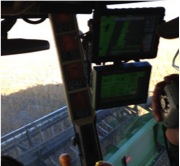
It’s November and another harvest has finished at my family’s farm in Minnesota. It was a very wet spring and summer followed by a very smooth harvest of wheat, soybeans, sugar beets and corn. Since the last three all need to be harvested around the same time, I don’t think my brother and nephews sleep in September, October or early November. I love harvest – except for the fact that I’m allergic to everything. I did get to visit this fall and my kids and I got to ride in the combine with my nephew as he harvested soybeans. The changes in the last 75 years have to rival that of the industrial revolution. My dad would have been in his early 80’s and when he was young, they cut wheat by hand and thrashed it in bundles. In fact, farming has experienced a generation of change in just the last 20 years since I moved away. I used to drive the combine, which was sayin g something because I’m not real mechanical compared to my brother and nephews. Now, the combine drives itself – quite literally – while using GPS locked onto a Russian navigation satellite that transmits to a receiver mounted on the roof. If that wasn’t enough to blow your mind, all imaginable metrics from the field, the fertilizer used, and the current yield, are monitored by software that is displayed on three iPads mounted in the cockpit. All of this technology has driven yield gains and efficiency, which my dad would have never believed. Global demand for corn and soybeans is rising and my family is doing everything it can to meet that demand – now if they would only get paid a fair price – that’s a whole blog for another time.
As amazing as all of this is, it’s only one example of the innovations happening in the world of farming. In full disclosure, the company I work for is involved in both of these examples but I’m not advocating for any particular technology or approach, just pointing out some amazing possibilities:
- First, there is an abandoned brewery in St. Paul, Minnesota that some entrepreneurs
 have transformed into a closed loop aquaponics system. What is that you may ask? Basically raising fish in tanks with a twist where the waste from the fish is actually used to fertilize plants, which are in turn grown hydroponically (in water). The whole system relies on some sophisticated filtration but uses very little energy and wastes very little water but on a small scale can produce protein, Tilapia fish,
  and fresh organic vegetables 24/7/365 in a place like Minnesota where it’s 13 degrees and dark more than it’s light this time of year. You can learn more on the Star Tribune, where they developed a nice graphic.
- Second, I learned about more large-scale fish farming that’s happening at projects like Open Blue, where they are farming Cobia, a premium white fish. It raises the fish from eggs to provide complete traceability from the farm to the marketplace. Another unique part of this project is the use of open ocean technology to culture fish in offshore enclosures, several miles off the coast of Panama in the deep sea. Now let’s talk about scale, the small farm in the brewery hopes to produce 5,000 fish a year, the folks at Open Blue are expecting to produce 1,600 tons of fish this year. Learn more here, especially of note is the great video done by CNN’s “The Next List.”
So, the next time you eat, think about where your food is coming from and then think about the fact that the world has approximately 2 billion people in the middle class today but will have more than 4 billion by 2030 – driving a huge need for increased food production and efficient use of resources. As a farm kid at heart, there’s no one I’d rather have at the center of these huge challenges than family farmers.

 building. It’s incredibly expensive to maintain a swimming pool with heat, chemicals, cleaning, etc. – but apparently the only time they want the pool to be used is one hour a day, in the morning, for water aerobics. There is to be no jumping, no toys, no splashing, basically no fun. In past year’s I’ve received warnings because my kids were playing with dive toys, throwing balls and because I was playing “marco polo” with them. Really? The other rule that I found myself breaking several times was walking into a “private” area of the beach and purchasing drinks from a “members only” snack bar. Don’t signs like this actually make you want to see if you can get in? Why would you refuse money from people who are thirsty on the beach? So, that retired people never have to stand in line at the snack bar? We’ve already established that all they’ve got is free time so what’s the big deal?
 The view from the suburbs